Invoice
Invoice vs. Receipt What’s the Difference and When Should You Use Each
A customer has paid you, and now they ask for a receipt. You look through your files and find the invoice you already sent. Are they asking for the same document?
Not quite.
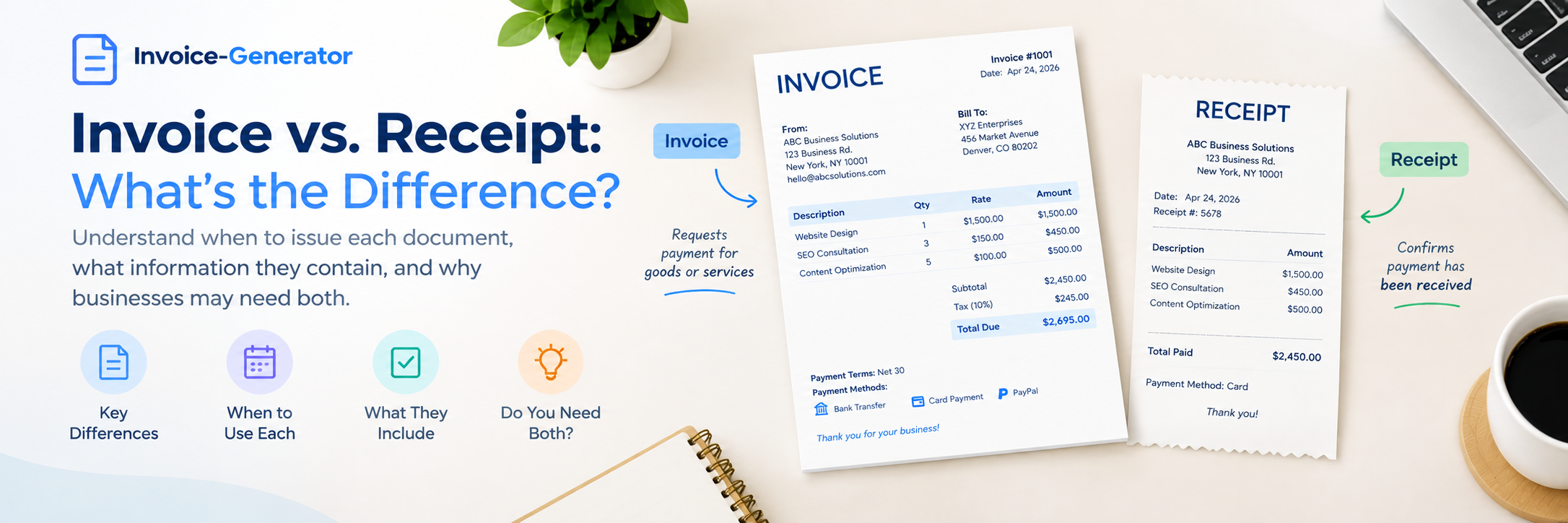
An invoice asks a customer to pay for products or services. A receipt confirms that the customer has already paid. The two documents can contain many of the same details, but they serve different purposes at different points in a transaction.
That difference matters for freelancers, contractors, consultants, retailers, and other small businesses. Knowing which document to send can prevent payment confusion and keep your records easier to follow.
If you are still getting familiar with invoices, our guide on what an invoice is, the different types, and how invoicing works provides a useful starting point.
What is the difference between an invoice and a receipt?
The simplest way to understand the invoice vs receipt difference is to look at when the document is used.
An invoice is a request for payment. You send it when a customer owes you money. It tells the customer what they purchased, how much they owe, when payment is due, and how they can pay.
A receipt is confirmation of payment. You issue it after receiving money from the customer. It shows what was paid, when it was paid, and often how the payment was made.
Consider a freelance web designer who completes a $1,500 website project.
The designer sends an invoice for $1,500 with a due date and payment instructions. The client then pays the full amount.
At that point, the business can issue a receipt confirming the $1,500 payment.
The easiest rule to remember is:
Invoice = payment requested.
Receipt = payment confirmed.
So, if you are still waiting for money, you generally need an invoice. If the money has already arrived, a receipt documents that payment.
Invoice vs receipt at a glance
The difference between invoice and receipt becomes easier to see when you put the two documents side by side.
| Feature | Invoice | Receipt |
|---|---|---|
| Main purpose | Requests payment | Confirms payment |
| Timing | Usually before payment | After payment |
| Amount shown | Amount due | Amount paid |
| Due date | Usually included | Usually not needed |
| Payment terms | Commonly included | Usually not included |
| Payment method | May include payment instructions | Often records how payment was made |
| Customer action | Customer needs to pay | Customer has already paid |
| Business record | Tracks money owed | Records money received |
An invoice starts the payment process. A receipt closes that part of the transaction by showing that payment happened.
The documents may look similar because both can contain the business name, customer information, item descriptions, amounts, and transaction dates. Their jobs are still different.
When should a small business send an invoice?
Send an invoice when you need to tell a customer how much they owe and how they should pay you.
A business might send an invoice after completing work, delivering goods, reaching a billing milestone, or starting work under agreed payment terms.
For example, a freelance writer completes a $900 content project. The writer sends an invoice showing the work completed, the $900 balance, payment instructions, and a due date.
The customer has not paid yet, so a receipt would be premature.
Invoices also make sense for deposits. Suppose a contractor requires a 40% deposit before beginning a $5,000 renovation project. The contractor can invoice the customer for the $2,000 deposit.
The same idea applies to longer projects.
A consultant working on a three-month project might bill the client at several agreed milestones. Each invoice tells the client what amount is due at that stage.
A useful invoice should make the payment request easy to understand. It should normally show:
- What products or services were provided
- How much each item costs
- The total amount due
- The invoice date
- The payment due date
- Available payment methods or instructions
- Relevant taxes or fees
If you want a deeper look at these details, see our guide to what an invoice should include.
The goal is simple. The customer should be able to look at the invoice and understand exactly what they need to pay.
When should a business give a receipt?
Give a receipt after you receive a payment and want to confirm that the transaction has been paid.
For a retail purchase, this may happen immediately at checkout. For a freelancer or service provider, the receipt may come after a customer pays an invoice.
Imagine a graphic designer sends a $750 invoice to a client. The client pays by bank transfer the next day.
The invoice explains the $750 amount that was owed. The receipt confirms that the designer received the $750 payment.
Receipts can also document partial payments.
Suppose a customer owes $2,000 but pays a $500 deposit first. The business can record the $500 payment and provide documentation showing what was received.
A receipt will commonly include:
- Business name
- Customer name when appropriate
- Receipt number
- Payment date
- Products or services covered
- Amount paid
- Payment method
- Related invoice number when applicable
Customers may keep receipts for their own transaction records, expense documentation, returns, warranties, or other purposes. Businesses should also retain their own payment records.
Is an invoice the same as a receipt?
No. An invoice and a receipt are not the same document.
An invoice says, "This is what you owe."
A receipt says, "This is what you paid."
The confusion happens because both documents can contain similar information. Both might list the customer, products or services, prices, taxes, and total amounts.
The difference is the payment status.
An unpaid invoice shows that money is still owed. A receipt shows that money has been received.
There is one situation that can make things less clear. A business may mark an invoice as paid after receiving payment. Depending on the business process, that paid invoice can provide evidence that the balance was settled.
Some invoicing systems use a paid invoice as part of their payment record. Other businesses issue a separate receipt. Requirements can also vary by jurisdiction and transaction type, so businesses should follow the rules that apply to them.
The safest approach is to keep the payment status clear. Do not mark an invoice as paid before the payment actually arrives.
What should an invoice and receipt include?
Invoices and receipts can share several details, but each document should focus on its specific purpose.
A good invoice should show
An invoice should give the customer enough information to understand the charge and complete the payment.
Include:
- Your business name and contact details
- Customer information
- Invoice number
- Invoice date
- Description of products or services
- Quantity, rate, and line totals where relevant
- Taxes or applicable fees
- Total amount due
- Payment terms
- Due date
- Payment instructions
For example, an invoice for a $1,200 design project should make clear what the $1,200 covers and when the customer needs to pay.
Our guide on how to create an invoice walks through the process in more detail for small businesses.
A good receipt should show
A receipt focuses on the payment that has already happened.
Include:
- Business name and contact information
- Customer information where appropriate
- Receipt number
- Payment date
- Products or services purchased
- Amount paid
- Payment method
- Related invoice number when applicable
- Remaining balance if the payment was only partial
The key difference is that the invoice focuses on what is owed, while the receipt focuses on what was paid.
Keeping those two purposes clear makes your records easier to understand later.
Do small businesses need both an invoice and a receipt?
For many business transactions, using both creates a clearer record.
The basic flow looks like this:
Invoice → Payment → Receipt
The invoice records the amount the customer was asked to pay. The payment changes the status of that amount. The receipt then documents the money the business received.
Consider a contractor who sends a $2,000 invoice.
The customer pays a $1,000 deposit. The contractor records that payment and provides confirmation showing that $1,000 was received.
Later, the customer pays the remaining $1,000. The final records can show the original invoice, the first payment, and the final payment.
This creates a much clearer transaction history than relying on a single document.
Invoices and receipts can also help businesses match what customers were charged with what they actually paid. That can make payment tracking easier.
If you want to understand how invoice numbers help connect invoices with payments and records, see our guide on simple invoice numbering systems and best practices.
Exact tax, legal, and recordkeeping requirements vary by country, state, industry, and transaction type. A business should follow the rules that apply to its situation rather than assuming every transaction must follow the same process.
What mistakes should businesses avoid?
A few simple mistakes can make invoices and receipts confusing.
Sending a receipt before payment. A receipt should confirm money that was actually received. Sending one before payment can create a misleading record.
Treating an unpaid invoice as proof of payment. An invoice shows what the customer owes. It does not, by itself, prove that the customer paid.
Failing to connect a receipt to the transaction. If possible, include the relevant invoice number or transaction reference on the receipt.
Using inconsistent dates or amounts. The payment record should match the amount and date actually received.
Ignoring partial payments. If a customer pays only part of an invoice, record the amount received and keep the remaining balance clear.
These details may seem minor when a business has only a few transactions. They become more useful when dozens or hundreds of payments need to be tracked.
How can you create an invoice without signing up?
Once you understand the difference between an invoice and a receipt, the next step is creating the invoice itself.
For businesses that need a quick option, Invoice-Generator.in lets you create a free invoice online without signing up.
You can enter your business and customer details, add products or services, customize the invoice, and download a print-ready PDF. The tool also supports multiple currencies and does not require an account to get started.
If you want a step-by-step walkthrough, read how to make an invoice online for free.
The process is useful when you need to create an invoice quickly without installing software or creating another account.
Common questions about invoices and receipts
Can I send an invoice after receiving payment?
Yes, a business may need to create or update an invoice after payment depending on its workflow. The document should accurately show the transaction and payment status.
Can a receipt be used instead of an invoice?
Usually, they serve different purposes. A receipt confirms payment, while an invoice requests payment. If a customer still owes money, a receipt does not replace the payment request.
Do I need to give a receipt after every payment?
The answer can depend on the type of business, transaction, and local requirements. Even when a separate receipt is not required, keeping a clear record of payments can help both the business and customer.
What happens after a customer pays an invoice?
Record the payment against the invoice and update its status. The business can then issue a receipt or other payment confirmation when appropriate.
Should I keep invoices and receipts?
Yes. Keeping both can create a clearer record of what was charged and what was actually paid. It can also make it easier to investigate payment questions later.
Know which document your customer needs
The invoice vs receipt difference comes down to one simple idea.
An invoice requests payment. A receipt confirms payment.
The invoice usually comes first. Once the customer pays, the business records that payment and can provide a receipt or other confirmation.
For a small business, keeping the two purposes separate makes customer communication and financial records easier to follow. The next time someone asks whether you need an invoice or a receipt, start with one question: Has the customer paid yet?
If the answer is no, you are usually dealing with an invoice. If the answer is yes, you are looking at payment confirmation.
Ready to send your next invoice?
Free, no sign-up, print-ready PDF in under a minute.