Invoice
Invoice vs. Credit Note: Differences and Examples
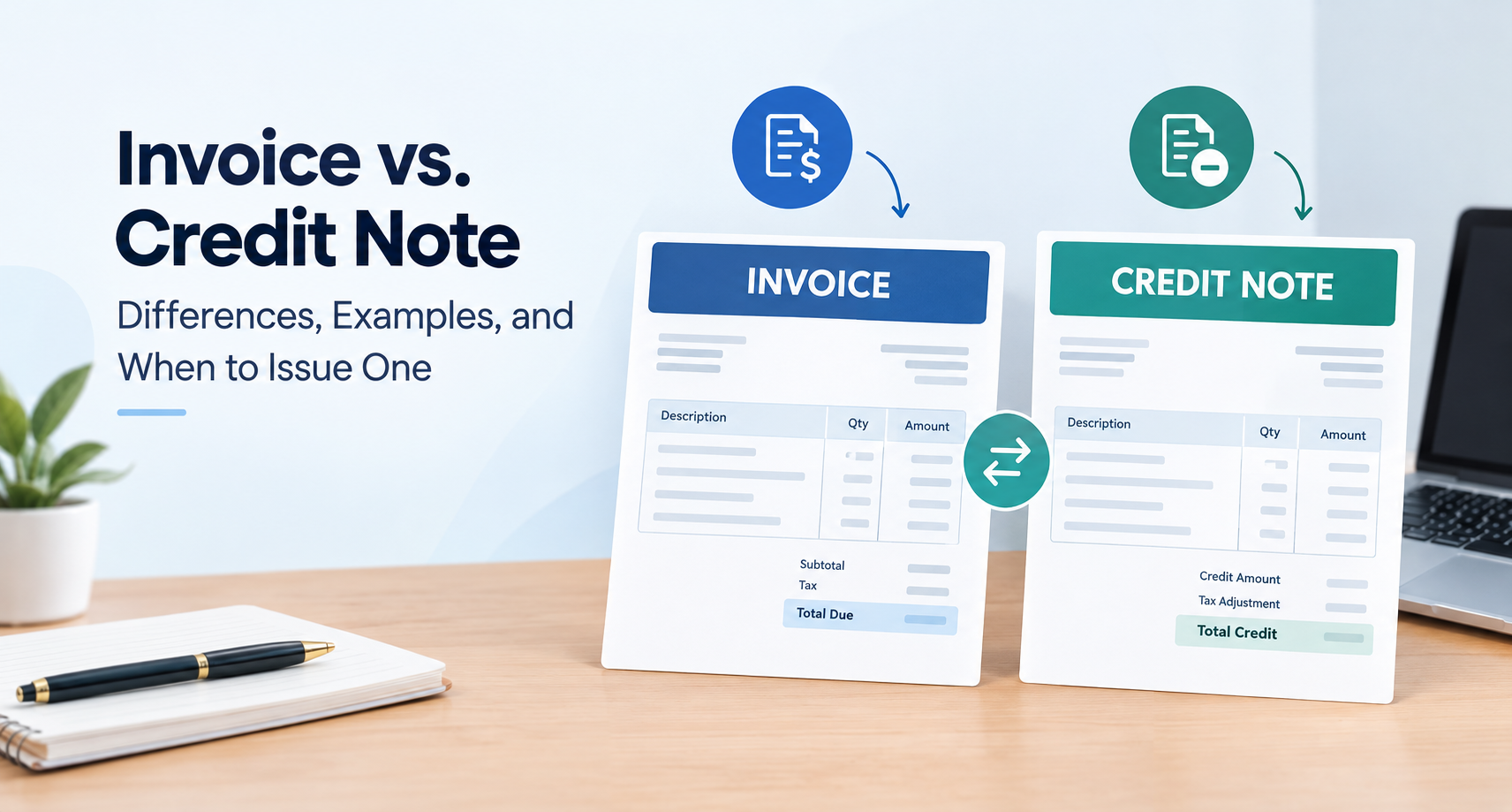
Invoice vs. Credit Note: Differences, Examples, and When to Issue One
An invoice requests payment for goods or services, while a credit note reduces or corrects an amount previously invoiced. Businesses commonly issue credit notes when a customer receives a refund, a discount is applied after invoicing, goods are returned, or an invoice contains an error that needs to be corrected.
Although invoices and credit notes are related, they serve different purposes. Understanding when to use each document helps you maintain accurate financial records, avoid confusion with customers, and keep your invoicing process organized.
In this guide, you'll learn the difference between an invoice and a credit note, when to issue a credit note, how to create one, and what to do if you have already sent an incorrect invoice.
Invoice vs. Credit Note: What's the Difference?
The main difference is that an invoice records a payment request, whereas a credit note records a reduction in the amount previously charged.
| Feature | Invoice | Credit note |
|---|---|---|
| Main purpose | Requests payment | Reduces or reverses a previously invoiced amount |
| When it's issued | When billing for goods or services | When a previous invoice needs a reduction or correction |
| Amount | Shows the amount payable | Shows the amount being credited |
| Common situations | Completed work, delivered products, agreed deposits or milestones | Returns, refunds, discounts, overcharges or billing corrections |
| Reference | Has its own unique invoice number | Has its own unique credit note number and usually references the original invoice |
| Effect on customer balance | Generally increases the amount owed | Generally reduces the amount owed or records a credit |
| Accounting records | Records the original sale or charge | Adjusts the relevant transaction according to the applicable accounting treatment |
Simple example: You invoice a customer $1,000 for a service. Later, you agree to give the customer a $200 reduction because part of the work was not completed. You may issue a credit note for $200 against the original invoice, leaving $800 payable if no other charges or payments apply.
The credit note documents the adjustment instead of silently changing the original invoice.
What Is an Invoice?
An invoice is a commercial document that tells a customer how much they owe for products or services. It normally includes the seller's details, customer information, invoice number, date, description of the work or products, applicable taxes, total amount due, and payment terms.
Businesses may issue invoices after delivering products, completing work, reaching a project milestone, or according to an agreed billing schedule.
For example, a freelance designer completes a project worth $1,500 and sends an invoice for that amount. The invoice records the charge and tells the customer how and when to pay.
If you need help preparing one, read our guide on how to create an invoice.
What Is a Credit Note?
A credit note is a document issued by a seller to record a reduction or adjustment to a previously invoiced amount.
Depending on the transaction and applicable rules, it may be used when:
-
A customer returns goods.
-
A product or service was overcharged.
-
A discount is agreed after the invoice was issued.
-
Part of an order is cancelled.
-
Some services were not delivered as agreed.
-
A refund or other billing adjustment needs to be documented.
A credit note usually identifies the seller and customer, includes a unique credit note number and issue date, references the original invoice, explains the reason for the adjustment, and shows the credit amount and any relevant tax adjustment.
The exact information required can vary by jurisdiction and transaction type.
Important: A credit note does not automatically mean money has been refunded. It records a credit or adjustment. Whether the business must return money, reduce an outstanding balance, or apply the credit to a future transaction depends on the circumstances and agreed terms.
When Should You Issue a Credit Note?
Issue a credit note when you need to document a valid reduction or correction to an invoice that has already been issued. The reason should be clear, and the credit note should be linked to the original transaction.
Here are common situations where a credit note may be appropriate.
1. A customer returns a product
Suppose a business invoices a customer $600 for six items at $100 each. The customer returns two items, and the return is accepted.
The business may issue a credit note for $200, plus any applicable tax adjustment.
The credit note records the value of the returned items and helps keep the sales and customer records accurate.
2. You charged the customer too much
Imagine you invoiced a client $1,200 for a service, but the agreed price was $1,000.
If the invoice has already been issued, a credit note for the $200 overcharge may be appropriate, subject to applicable invoicing requirements.
This documents the adjustment and helps prevent the customer from being charged more than agreed.
3. You agreed to a discount after invoicing
A customer may qualify for a discount that was not included in the original invoice.
For example, you issued an invoice for $2,000 and later agreed to a $150 discount. A credit note may document the $150 reduction, with any applicable tax adjustment.
The revised amount payable would be $1,850 if no other changes or payments apply.
4. You cancelled part of an order
Suppose a customer ordered products worth $1,500, but part of the order was cancelled after invoicing. If the cancelled portion was worth $400, a credit note may be used to document that reduction.
The document should identify the affected goods or services and the amount being credited.
5. You need to correct a billing error
An invoice might contain an incorrect quantity, price, discount, or other charge.
If the invoice has already been issued, the right correction method depends on the type of error and the rules that apply. A credit note may be needed to reverse the incorrect amount, followed by a corrected invoice where appropriate.
Do not assume that editing a PDF and resending it is sufficient. Keep a clear record of the original document and the correction.
Credit Note Example: How It Works in Practice
Let's look at a simple example.
A small business issues an invoice for website design services.
Original invoice
| Description | Amount |
|---|---|
| Website design | $1,000 |
| Applicable tax | $100 |
| Total invoiced | $1,100 |
After reviewing the project, the business agrees to credit the customer $200 for a portion of the work that was not delivered.
Assume, for illustration, that the tax associated with the credited work is $20.
Credit note
| Description | Amount |
|---|---|
| Credit for undelivered work | $200 |
| Related tax adjustment | $20 |
| Total credit | $220 |
Adjusted balance
| Calculation | Amount |
|---|---|
| Original invoice | $1,100 |
| Less credit note | −$220 |
| Adjusted amount payable | $880 |
The customer now owes $880, assuming the original invoice remains unpaid and there are no other adjustments.
These figures are hypothetical. Tax treatment depends on the applicable jurisdiction, transaction, and tax rules. For a practical explanation of invoice tax calculations, see how to calculate tax on an invoice.
What Should a Credit Note Include?
A credit note should make it easy for both parties to understand what is being adjusted and why.
Include the following details where applicable:
-
Seller information: Business name and relevant contact or registration details.
-
Customer information: Name and billing details.
-
Credit note number: A unique reference for the document.
-
Issue date: The date the credit note is issued.
-
Original invoice number: The invoice being adjusted.
-
Reason for the credit: For example, returned goods, an overcharge, or an agreed discount.
-
Description of the adjustment: Explain which product, service, or charge is affected.
-
Credit amount: Show the amount being credited.
-
Tax adjustment: Include the relevant tax details when applicable.
-
Total credit: Clearly show the overall amount being credited.
-
Payment or account treatment: Explain whether the credit will reduce the outstanding balance, be refunded, or be applied according to the agreed arrangement.
For a more complete overview of standard invoice details, see what an invoice should include.
How to Issue a Credit Note Step by Step
The process can vary depending on your accounting system and local requirements, but these steps provide a useful starting point.
Step 1: Find the original invoice
Locate the invoice that needs an adjustment. Check its number, date, customer details, and original amount.
Step 2: Confirm the reason for the credit
Identify exactly why the amount needs to change. This might be a product return, an agreed discount, an overcharge, or a cancellation.
If necessary, confirm the adjustment with the customer before issuing the document.
Step 3: Calculate the credit amount
Work out the amount being credited, including any applicable tax adjustment.
Double-check the calculation before issuing the credit note. If only one line item is affected, make sure the credit reflects that item rather than the entire invoice.
Step 4: Create a unique credit note number
Assign the credit note its own unique reference number. Do not reuse the original invoice number as the credit note number.
Your numbering system should be consistent and suitable for your business and applicable recordkeeping requirements. Our guide on how to number invoices explains how to maintain a consistent numbering system.
Step 5: Reference the original invoice
Include the original invoice number so the customer and anyone reviewing your records can connect the two documents.
Step 6: Explain the adjustment
State what is being credited and why. A description such as “Credit for two returned items” is more useful than simply writing “Adjustment.”
Step 7: Review and issue the credit note
Check the amounts, dates, customer information, tax details, and references. Then send the credit note to the customer and update your accounting or invoicing records as appropriate.
Keep a copy of the original invoice and the credit note together in your records. For practical recordkeeping tips, see how to organize invoices.
How to Correct an Invoice After Sending It
If you discover an error after sending an invoice, first identify what is wrong and whether the invoice has already been paid or reported for tax purposes.
The correct process depends on the error and the rules in your jurisdiction.
-
If the invoice has not yet been issued or finalized: You may be able to correct it before sending it, depending on your process and the applicable rules.
-
If the invoice has been issued: Keep the original record and use the required correction method. This may involve a credit note and, where appropriate, a replacement or corrected invoice.
-
If the customer has already paid: You may need to document a refund, credit against another balance, or other agreed settlement.
-
If tax was reported: Check whether the adjustment requires a corresponding tax or accounting correction.
For example, if you invoiced $950 instead of the agreed $850, the $100 difference needs to be documented appropriately. The correct approach is not always to delete the original invoice and create a new one without an audit trail.
For tax-related adjustments, verify the rules that apply to your business or consult an accountant.
Can You Issue a Credit Note Instead of a Refund?
Yes, a credit note can document an amount owed back to the customer, but issuing a credit note and paying a refund are not the same thing.
A credit note records the adjustment. The business may then:
-
Reduce the customer's outstanding invoice balance.
-
Refund the amount, where appropriate.
-
Apply the credit to a future purchase if agreed and permitted.
-
Keep the amount as a customer credit until it is used or settled.
The appropriate option depends on the agreement with the customer, the transaction, and applicable legal and accounting requirements.
For example, if a customer has an unpaid invoice of $700 and receives a valid credit of $100, the remaining balance may become $600. If the customer already paid the full $700, the business may need to refund the $100 or handle it through another agreed method.
Can You Cancel an Invoice by Issuing a Credit Note?
A credit note may be used to reverse all or part of an invoice, depending on the applicable rules and the reason for the cancellation.
If the entire transaction is cancelled, the credit note may cover the full invoiced amount. If only part of the order is cancelled, it may cover only the affected portion.
However, the correct document and process depend on local invoicing requirements and the status of the transaction. A credit note should not be treated as a universal substitute for every invoice cancellation procedure.
Is a Credit Note the Same as a Debit Note?
No. A credit note generally records a reduction in an amount previously invoiced, while a debit note can be used in certain business and accounting contexts to record an additional amount due or request an adjustment.
The exact meaning and usage of debit notes vary by jurisdiction, industry, and whether the document is issued by the buyer or seller. Follow the terminology and process required for your transaction rather than assuming the terms are interchangeable.
Common Credit Note Mistakes to Avoid
A credit note is useful only if it accurately documents the adjustment. Watch out for these common mistakes.
Not referencing the original invoice: Without the original invoice number, it can be difficult to trace the reason for the adjustment.
Using duplicate credit note numbers: Give each credit note its own unique reference according to your numbering system.
Failing to explain the reason: A vague description makes the adjustment harder to review later.
Getting the tax adjustment wrong: Tax treatment can depend on the transaction and jurisdiction. Verify the applicable rules instead of guessing.
Changing the original invoice without keeping a record: Maintain a clear audit trail of the original invoice and the documents used to correct it.
Confusing a credit note with a refund: A credit note records an adjustment; it does not prove that money has been returned to the customer.
Forgetting to update the records: Make sure the credit is reflected in the customer's account and relevant accounting records.
Frequently Asked Questions
What is the difference between an invoice and a credit note?
An invoice requests payment for goods or services. A credit note records a reduction or correction to an amount previously invoiced, such as a refund adjustment, return, discount, or overcharge.
When should I issue a credit note?
Issue a credit note when you need to document a valid reduction or correction to an invoice that has already been issued. Common reasons include returned goods, agreed discounts, overcharges, cancelled items, or services that were not delivered as agreed.
Can I issue a credit note without an invoice?
A credit note normally relates to a previous invoice or transaction that needs adjustment. If no invoice was issued, check the appropriate document and procedure for your transaction and local requirements before creating a credit note.
Does a credit note mean the customer has received a refund?
No. A credit note documents a credit or reduction. The business may still need to refund money, reduce an outstanding balance, or apply the credit according to the agreement and applicable rules.
Can I issue a credit note for an incorrect invoice?
Yes, a credit note may be appropriate when an issued invoice needs a reduction or correction. Depending on the error and local rules, you may also need to issue a corrected invoice or follow another formal correction process.
Can a credit note be issued after an invoice has been paid?
It may be possible to issue a credit note after payment to document a valid adjustment. The business must then determine how to settle the credit, such as issuing a refund or applying it to another amount owed, in accordance with the applicable rules.
Is a credit note positive or negative?
A credit note represents a reduction in the amount previously charged. It may display the credit as a positive amount labelled “credit” or as a negative adjustment, depending on the document format and accounting system.
Does a credit note need a unique number?
A unique credit note number is strongly recommended and may be required under applicable rules. It helps identify the document and maintain a clear record of adjustments.
Should a credit note include tax?
Where relevant, the credit note should reflect the applicable tax adjustment. The exact treatment depends on the original transaction and the tax rules in the relevant jurisdiction.
Can I edit an invoice instead of issuing a credit note?
That depends on whether the invoice has been issued and the applicable invoicing rules. Once an invoice has been formally issued, you should not assume that editing the file or replacing it silently is sufficient. Follow the required correction process and retain appropriate records.
Final Thoughts: Invoice vs. Credit Note
An invoice and a credit note serve different purposes, but both help businesses maintain clear billing records.
Use an invoice to request payment for products or services. Use a credit note when a previously invoiced amount needs a documented reduction or correction.
The important thing is to explain the adjustment, reference the original transaction, check the figures and applicable tax treatment, and keep the records connected.
If you need to bill a customer for new work, you can use Invoice-Generator.in to create a professional invoice online. For adjustments to an existing invoice, make sure you follow the appropriate credit note or correction process for your business and location.
Ready to send your next invoice?
Free, no sign-up, print-ready PDF in under a minute.