Invoice
What Does Net 30 Mean on an Invoice? Examples and Due-Date Tips
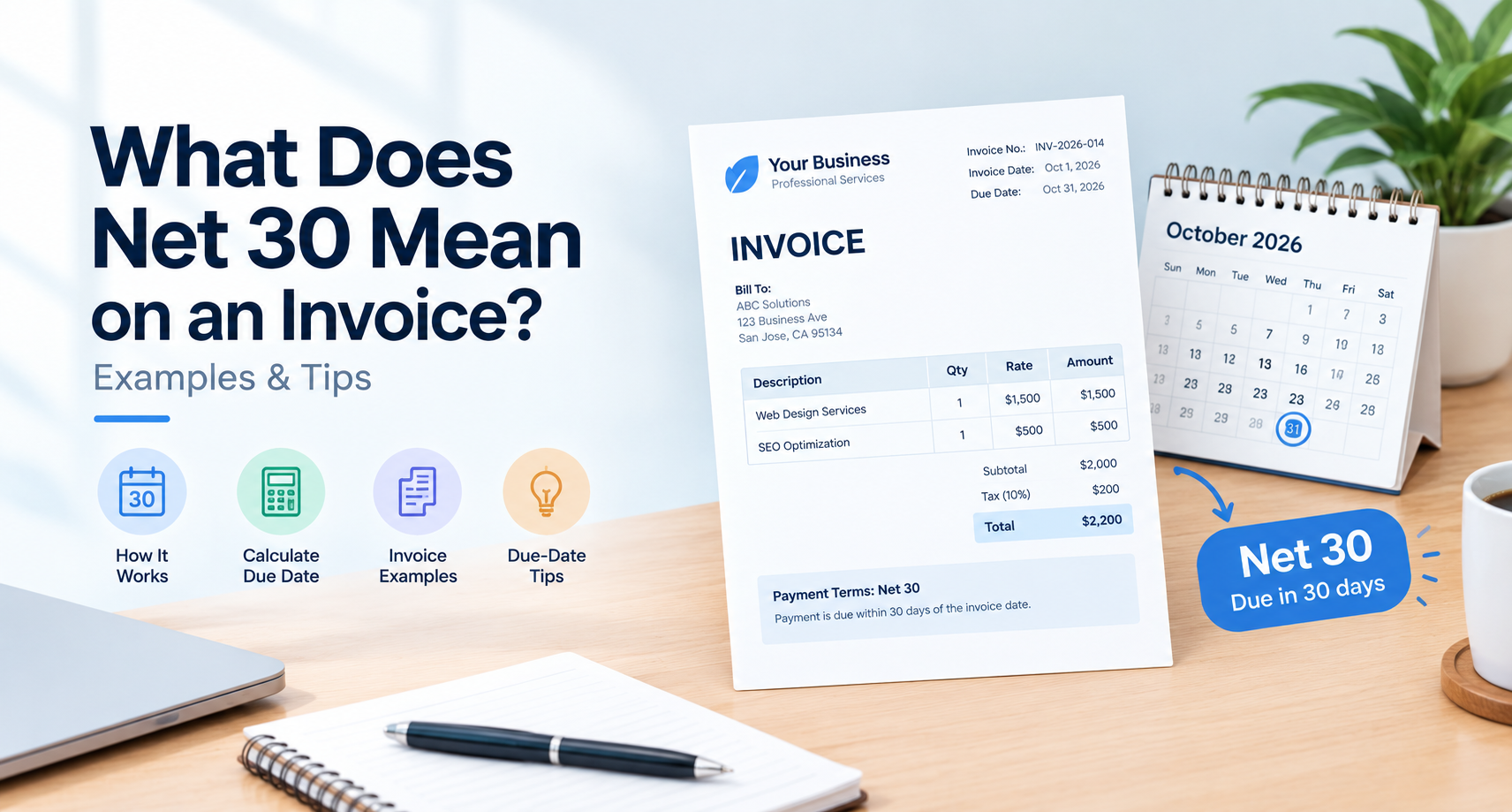
Net 30 means the full outstanding invoice amount is generally due within 30 days under the agreed payment terms. For example, if an invoice is dated October 1 and the agreement specifies payment within 30 days of the invoice date, payment would generally be due October 31.
Businesses use Net 30 to give customers time to process and pay invoices. These terms are common in business-to-business transactions, including consulting, marketing, construction, wholesale, and professional services.
However, writing “Net 30” on an invoice is not always enough. You also need to understand how the due date is calculated, when the 30-day period starts, and what to do if payment does not arrive on time.
This guide explains Net 30 with practical examples, due-date calculations, invoice wording, and tips for managing late payments.
What Does Net 30 Mean on an Invoice?
Net 30 generally means the customer must pay the full outstanding invoice balance within 30 days under the agreed payment terms.
The word “net” refers to the amount payable after applicable discounts or adjustments. The number “30” specifies the payment period.
For example, suppose you complete a $2,000 consulting project and send your client an invoice with these details:
-
Invoice date: October 1, 2026
-
Invoice amount: $2,000
-
Payment terms: Net 30
-
Due date: October 31, 2026
The client is expected to pay the outstanding $2,000 by the agreed due date, assuming there are no discounts, credits, partial payments, or other adjustments.
Net 30 generally refers to calendar days, not 30 business days, unless the agreement specifies a different calculation.
For a broader comparison of Net 15, Net 30, deposits, and other options, read our guide to invoice payment terms explained.
How Does Net 30 Work? A Simple Example
Imagine you run a small marketing agency and finish a website optimization project for a client.
You send an invoice for $1,500 on October 5, 2026, with Net 30 payment terms.
| Invoice detail | Example |
|---|---|
| Invoice date | October 5, 2026 |
| Invoice amount | $1,500 |
| Payment terms | Net 30 |
| Due date | November 4, 2026 |
| Expected payment | Full outstanding balance by the due date |
The client has 30 days from the invoice date under this example's terms. If the full payment has not arrived by November 4, the invoice may become overdue after that deadline, depending on the agreement and applicable rules.
You do not need to send a new invoice every time you remind the client about payment. Instead, reference the original invoice number and due date in your follow-up.
The important point is that Net 30 establishes a payment deadline. It does not guarantee that the customer will pay on time.
How to Calculate a Net 30 Due Date
To calculate a Net 30 due date, start with the date specified in your agreement, usually the invoice date, and apply the agreed 30-day period.
Invoice date + 30 calendar days = Net 30 due date
Here are some examples using a standard 30-calendar-day calculation.
| Invoice date | Net 30 due date |
|---|---|
| October 1, 2026 | October 31, 2026 |
| October 5, 2026 | November 4, 2026 |
| October 15, 2026 | November 14, 2026 |
| November 1, 2026 | December 1, 2026 |
| December 10, 2026 | January 9, 2027 |
Your contract, local rules, or invoicing system may define the calculation differently, so confirm the actual due date before sending the invoice.
Does the invoice date count as day one?
In ordinary Net 30 calculations, the due date is often determined by adding 30 days to the invoice date rather than treating the invoice date itself as day one. However, the wording of your agreement matters.
For example, an invoice dated October 1 with payment due “30 days after the invoice date” would generally have a due date of October 31.
If your contract specifies a different counting method, follow that agreement where valid.
What if the due date falls on a weekend or holiday?
Do not automatically assume the deadline moves to the next business day.
Some agreements specify that payment is due on the stated calendar date. Others contain rules for weekends, public holidays, or bank processing days.
If the due date falls on a weekend or holiday, check the payment terms and applicable rules. For clarity, show the exact due date on the invoice and agree in advance on how non-business days will be handled.
When Does the Net 30 Period Start?
The starting point depends on the wording of the agreement. Net 30 is often calculated from the invoice date, but not every contract uses that method.
1. Net 30 from the invoice date
This is a common arrangement.
-
Invoice issued: October 1
-
Payment terms: Net 30 from the invoice date
-
Expected due date: October 31
The payment period starts from the date specified on the invoice, subject to the agreed terms.
2. Net 30 from receipt of the invoice
Some agreements calculate the payment period from the date the customer receives the invoice.
For example, if an invoice is dated October 1 but received on October 3, the due date may be calculated from October 3 if the contract specifically says “Net 30 from receipt.”
This distinction can matter when invoices are sent by email, through a procurement portal, or by post.
3. Net 30 after delivery or completion
Some business contracts connect payment deadlines to delivery, acceptance, or completion of work.
For example, a contract might require payment within 30 days after the customer accepts a completed project.
That is not necessarily the same as Net 30 from the invoice date. The starting point should be clear in the contract and reflected accurately in your invoicing process.
Practical tip: If you are agreeing on payment terms with a new client, confirm which event starts the 30-day period before you begin work.
Net 30 vs. Net 15: What's the Difference?
Net 15 and Net 30 both give customers a defined period to pay. The difference is how long the payment window lasts.
| Feature | Net 15 | Net 30 |
|---|---|---|
| Payment period | Generally 15 days | Generally 30 days |
| Customer payment window | Shorter | Longer |
| Potential cash-flow effect | Money may arrive sooner | Payment may take longer |
| Common consideration | Useful when a shorter payment cycle suits the business | May fit clients with established accounts-payable processes |
For example, if you issue an invoice on October 1:
-
Net 15: Payment would generally be due October 16.
-
Net 30: Payment would generally be due October 31.
Net 15 may suit freelancers or small service providers who need to collect payments sooner. Net 30 may be more practical when working with businesses that process supplier payments on established schedules.
Neither option is automatically better. Consider your expenses, project size, customer relationship, and cash-flow needs before agreeing to a payment period.
Is Net 30 Good for Small Businesses?
Net 30 can help small businesses work with clients who need time to process invoices. It may also make your services easier to purchase for customers who expect standard business payment terms.
However, there is a trade-off: you may have to cover your own expenses before the customer pays you.
Consider a contractor who buys $3,000 worth of materials to complete a project. If the contractor invoices the customer after finishing the work and offers Net 30, the business may need to wait for payment while covering material costs, wages, and other expenses.
Before offering Net 30, consider:
-
Your operating costs: Can you cover expenses while waiting for payment?
-
The customer's payment history: Has the customer paid previous invoices on time?
-
The project size: Would a deposit reduce the financial burden?
-
The contract: Are the payment deadline and conditions clear?
-
Your follow-up process: Can you track due dates and follow up promptly?
For larger projects, you might agree to a deposit or milestone payments instead of waiting until the entire project is finished. Make sure the arrangement is agreed upon before work begins.
How to Write Net 30 Payment Terms on an Invoice
Your invoice should make the payment deadline easy to understand. You can include Net 30 and the actual calendar due date together.
Simple Net 30 wording
Payment Terms: Net 30. Payment is due within 30 days of the invoice date.
Net 30 with an exact due date
Payment Terms: Net 30. Payment due by October 31, 2026.
Net 30 with payment instructions
Payment Terms: Net 30. Please pay the outstanding balance by October 31, 2026, using the payment method listed below.
Net 30 for business clients
Payment Terms: Payment is due within 30 calendar days of the invoice date. Please include the invoice number as your payment reference.
Use wording that matches your actual agreement. Do not add payment deadlines, fees, discounts, or other conditions that the customer has not agreed to.
It is also important to include the invoice number, issue date, amount due, customer details, and payment instructions. See our checklist of what an invoice should include.
What Happens If a Customer Does Not Pay Within 30 Days?
If the agreed Net 30 deadline passes without full payment, the invoice may become overdue. Your next step should be to check the invoice, confirm that payment has not arrived, and contact the customer professionally.
Step 1: Check the invoice details
Confirm the invoice number, amount, invoice date, due date, and payment instructions. Check your bank account or payment records to ensure the payment has not already arrived.
Step 2: Send a friendly payment reminder
Start with a polite message that identifies the invoice and its due date.
Example:
Subject: Payment reminder for invoice INV-2026-014
Hi Alex,
I’m following up on invoice INV-2026-014 for $1,500, which was due on October 31, 2026.
Could you please confirm the expected payment date? Let me know if you need another copy of the invoice.
Thank you.
This approach gives the customer an opportunity to explain a delay without making the conversation unnecessarily confrontational.
For more ready-to-use messages, see our guide on how to follow up on an unpaid invoice.
Step 3: Follow up if payment remains outstanding
If the customer does not respond, follow up again according to your normal process and the terms of your agreement.
Keep a record of your messages and any payment commitments.
You can also read our guide on how to handle late payments for ways to manage overdue balances and reduce avoidable payment delays.
Step 4: Review any late-payment provisions
If your agreement includes late fees or interest, check the wording and the rules that apply to your transaction before charging them.
Late-payment rules vary by jurisdiction and contract. Do not assume that writing Net 30 automatically gives you the right to impose a fee.
Can You Change Net 30 Terms After Sending an Invoice?
You should not assume you can change an agreed payment deadline unilaterally after issuing an invoice.
If you want to move a customer from Net 30 to Net 15, or extend a deadline because the customer needs more time, discuss the change and document the agreement.
For example, if an invoice is due on October 31 and both parties agree to extend payment until November 15, keep a record of the revised deadline.
For future invoices, update your contract or payment terms so that both parties know what to expect.
Consistency helps prevent disputes about when payment was due and whether an invoice is overdue.
Common Net 30 Mistakes to Avoid
Net 30 is straightforward when the agreement and invoice are clear. Problems often arise when businesses leave room for interpretation.
Showing Net 30 without a due date
Customers may have to calculate the deadline themselves. Include the exact date whenever possible.
Confusing calendar days with business days
Net 30 generally refers to calendar days unless the agreement specifies otherwise. Do not assume it means 30 working days.
Using the wrong starting date
An agreement may calculate the period from the invoice date, receipt of the invoice, or another specified event. Check the wording before calculating the deadline.
Sending invoices late
If your agreement allows you to invoice after completing a project or milestone, send the invoice promptly. Unnecessary delays in issuing invoices can push your expected payment further into the future.
Forgetting to track due dates
Keep a record of invoice dates, due dates, amounts, and payment status. Our guide on how to track invoices and payments explains how to create a simple tracking system.
Assuming Net 30 guarantees payment
Payment terms establish expectations, but customers may still pay late. A clear reminder process and accurate records help you manage outstanding balances.
Using inconsistent invoice numbers
A consistent numbering system makes it easier to identify invoices, match payments, and follow up with customers. Read our guide to how to number invoices for practical examples.
Frequently Asked Questions About Net 30
What does Net 30 mean in simple terms?
Net 30 generally means the customer must pay the full outstanding invoice amount within 30 days under the agreed payment terms, often calculated from the invoice date.
Does Net 30 mean 30 calendar days or 30 business days?
It generally means 30 calendar days unless the agreement specifies business days or another calculation method. Calendar days include weekends and holidays.
If an invoice is dated October 1, when is Net 30 due?
Using a standard 30-calendar-day calculation from the invoice date, payment would generally be due October 31. Always check the contract and the exact wording of the payment terms.
Does Net 30 start on the invoice date or the date the customer receives it?
It depends on the agreement. Net 30 is commonly calculated from the invoice date, but some contracts start the period when the invoice is received, goods are delivered, or work is accepted.
Does Net 30 mean I have to wait 30 days to pay?
No. Net 30 establishes the latest payment deadline under the agreed terms, not a mandatory waiting period. A customer can generally pay earlier unless the agreement provides otherwise.
Can I ask for payment before the Net 30 deadline?
You can contact the customer about payment, but your agreed terms determine when payment is due. If you want a shorter deadline, agree on the change with the customer rather than assuming you can impose it.
Is Net 30 the same as Due on Receipt?
No. Net 30 generally gives the customer 30 days to pay, while Due on Receipt means payment is expected when the invoice is received, subject to the applicable agreement and rules.
Can a small business offer Net 30?
Yes. A small business can offer Net 30 when it suits its cash flow and customer agreements. Consider deposits or milestone payments for projects that require substantial upfront expenses.
What happens if a customer pays after the Net 30 due date?
The invoice may become overdue. Check the agreed terms, confirm the payment status, and send a professional reminder. Late fees or interest should only be applied where permitted by the agreement and applicable rules.
Should I put the exact due date on a Net 30 invoice?
Yes. Showing both “Net 30” and the calendar due date reduces confusion and gives both parties a clear reference point.
Final Thoughts: Understanding Net 30 Payment Terms
Net 30 gives customers a defined period to pay an invoice, generally 30 calendar days under the agreed terms. It can help businesses work with clients who use standard payment-processing cycles, but it also means you may wait longer to receive money for completed work.
Before offering Net 30, make sure the payment period fits your cash flow, the starting date is clear, and the invoice shows the exact due date. Track outstanding invoices and follow up professionally when payments are late.
If you need to create an invoice with clear payment details, use Invoice-Generator.in to prepare a professional invoice online for free, without signing up.
Ready to send your next invoice?
Free, no sign-up, print-ready PDF in under a minute.