Invoice
Invoice vs. Purchase Order: Key Differences and When to Use Each
If you run a small business, work as a freelancer, or manage purchasing for a company, you have probably come across invoices and purchase orders. They may contain similar details, but they serve different purposes.
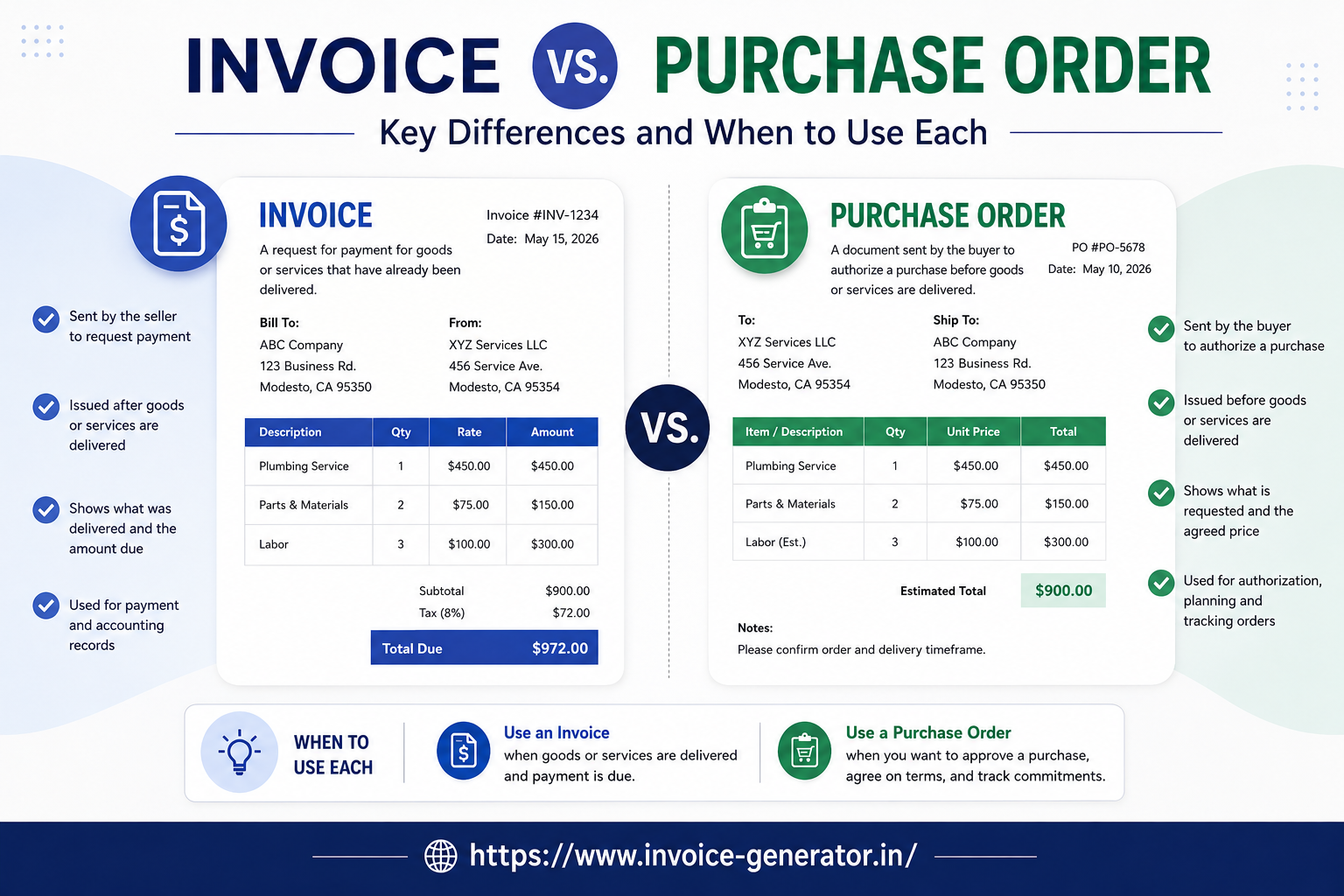
The main difference between an invoice and a purchase order is who typically creates it and why. A buyer creates a purchase order (PO) to request or authorize a purchase. A seller sends an invoice to request payment for goods or services.
Understanding the difference helps you avoid billing confusion, keep financial records organized, and make sure both sides agree on what was ordered and what needs to be paid.
What Is the Difference Between an Invoice and a Purchase Order?
An invoice and a purchase order are two separate business documents used at different stages of a transaction.
| Feature | Purchase Order (PO) | Invoice |
|---|---|---|
| Created by | Usually the buyer | Usually the seller |
| Main purpose | To request or authorize a purchase | To request payment |
| Typical timing | Before goods or services are supplied | After delivery or according to the agreed billing schedule |
| Includes | Items or services ordered, quantities, prices, and delivery details | Items or services billed, amounts due, invoice date, and payment terms |
| Identifying number | PO number | Invoice number |
| Used by | Purchasing and procurement teams | Accounts payable and accounts receivable teams |
| Payment requested? | Not usually | Yes |
| Common use | Approving and tracking a purchase | Billing the customer and tracking payment |
In simple terms: a purchase order explains what the buyer wants to purchase, while an invoice explains what the seller is charging the buyer.
The exact process can vary by company, industry, and contract. For example, some businesses require a PO before accepting an invoice, while others operate without purchase orders.
What Is a Purchase Order?
A purchase order is a document a buyer sends to a seller to specify the goods or services they want to purchase under stated terms.
For example, imagine a restaurant needs 20 tables and 80 chairs for a new dining area. Before placing the order, its purchasing manager sends a purchase order to the furniture supplier.
The purchase order might include:
-
Buyer and supplier details
-
Purchase order number
-
Description of the furniture
-
Quantity of each item
-
Agreed price
-
Delivery address and expected date
-
Applicable terms and conditions
Once the supplier accepts the order, the purchase order helps both parties refer to the agreed items, quantities, and terms.
Why do businesses use purchase orders?
Purchase orders help businesses control spending and maintain a clear record of approved purchases.
They can help a business:
-
Get approval before spending money.
-
Communicate exactly what it wants to buy.
-
Track orders with suppliers.
-
Compare the original order with the goods received.
-
Check supplier invoices before paying them.
For a small business, a purchase order can be especially useful when buying equipment, stock, materials, or services regularly.
However, not every purchase requires a formal PO. The process depends on the business's purchasing policies and the agreement between the buyer and seller.
What Is an Invoice?
An invoice is a document a seller sends to a buyer to request payment for goods or services supplied, or as required under an agreed billing arrangement.
For example, after delivering the restaurant furniture, the supplier sends an invoice showing the items supplied, the total amount due, and the payment deadline.
A typical invoice includes:
-
Seller and customer details
-
A unique invoice number
-
Invoice date and payment due date
-
Description of the goods or services
-
Quantities, rates, and line-item amounts
-
Applicable taxes and discounts
-
Total amount due
-
Payment terms and instructions
The information required can vary by location and transaction. For a practical breakdown, see our guide to what an invoice should include.
Why do businesses use invoices?
Invoices create a record of what a seller is charging and help both parties manage payments.
They help businesses:
-
Request payment from customers.
-
Track unpaid and overdue amounts.
-
Match incoming payments to the correct transaction.
-
Maintain accounting records.
-
Follow up when a payment is late.
If you sell products or provide services, a clear invoice makes it easier for customers to understand the charge and process payment.
Purchase Order vs. Invoice: A Practical Example
Let's look at a simple example to see how the two documents work together.
Imagine ABC Office Supplies receives an order from a marketing agency for new office furniture.
<text strong>Step 1: The buyer creates a purchase order</text>
The marketing agency wants to buy 10 office desks at $150 each.
Its purchase order contains the agreed items, quantities, and prices.
| Item | Quantity | Unit price | Amount |
|---|---|---|---|
| Office desks | 10 | $150 | $1,500 |
| Order total before tax | $1,500 |
The agency sends the purchase order to ABC Office Supplies according to its purchasing process.
<text strong>Step 2: The supplier delivers the desks</text>
ABC Office Supplies prepares and delivers the 10 desks. The supplier and buyer can use the PO to confirm what was ordered.
<text strong>Step 3: The supplier sends an invoice</text>
After delivery, the supplier sends an invoice requesting payment.
The invoice references the same purchase and includes the invoice number, amount due, and agreed payment terms.
For this example, assume the invoice amount remains $1,500 before any applicable tax or other agreed charges.
<text strong>Step 4: The buyer checks the documents</text>
The agency's accounts payable team compares the invoice with the purchase order and, where applicable, the delivery record.
It checks that the quantity, prices, and other details match before approving payment.
This process is often called three-way matching when the buyer compares the purchase order, receiving record, and supplier invoice.
The key point is that the purchase order records the authorized purchase, while the invoice records the supplier's request for payment.
When Should You Use a Purchase Order?
Use a purchase order when a business needs to document, approve, or track a purchase before committing to it.
Common situations include:
1. Buying products or inventory
A retailer ordering stock from a supplier may use a PO to specify product names, quantities, prices, and delivery requirements.
2. Purchasing equipment
A company buying laptops, office furniture, machinery, or other equipment may require an approved PO before the order is placed.
3. Managing large projects
A construction company may use purchase orders to track materials, equipment rentals, or subcontracted work.
4. Controlling business spending
A business with multiple departments may require a PO so purchases are approved by the right person before money is committed.
5. Working with suppliers that require POs
Some larger companies will not process a supplier invoice unless it includes a valid purchase order number.
If your customer uses this system, ask for the PO number and any invoicing instructions before you send the invoice.
When Should You Issue an Invoice?
Issue an invoice when you need to request payment according to your agreement with the customer.
The appropriate timing depends on the contract and the type of work.
1. After delivering products
A supplier may invoice a customer after the goods have been delivered, as agreed.
2. After completing a service
A consultant, designer, or repair professional may send an invoice after completing the agreed work.
3. At project milestones
A web development agency may invoice 30% at the start of a project, 40% after design approval, and the remaining 30% at completion, if those milestones are part of the agreed payment schedule.
4. For recurring services
A marketing consultant or software provider may invoice monthly according to an agreed subscription or retainer arrangement.
5. When requesting an advance payment
A business may request a deposit or advance payment before beginning work, depending on its agreement with the customer.
Before sending an invoice, check the agreed billing schedule, required customer details, payment terms, and any purchase order instructions.
For a step-by-step process, read our guide on how to create an invoice.
What Is a Purchase Order Number on an Invoice?
A purchase order number on an invoice is the buyer's reference number for the original order.
It helps the buyer connect the invoice with the purchase that was approved.
For example, a supplier might issue the following invoice:
-
Invoice number: INV-2026-104
-
Purchase order number: PO-7845
-
Customer: ABC Marketing
-
Amount due: $1,500
-
Payment terms: Net 30
Here, INV-2026-104 identifies the supplier's invoice, while PO-7845 identifies the buyer's purchase order.
They are not interchangeable.
Why should you include a PO number on an invoice?
If a customer requires purchase order references, including the correct number can help its accounts payable team:
-
Identify the approved purchase.
-
Match the invoice with the order.
-
Check the billed quantity and price.
-
Route the invoice for approval.
-
Avoid processing delays caused by missing information.
If a customer has provided a PO number, place it clearly on the invoice in a field such as Purchase Order Number or PO Reference.
Do not invent a PO number if the customer has not provided one. Ask the customer's purchasing or accounts payable team whether a PO is required.
Can You Send an Invoice Without a Purchase Order?
Yes, you can often send an invoice without a purchase order if the buyer does not require one and the transaction terms allow it.
Many freelancers, consultants, independent contractors, and small service businesses invoice clients without using formal purchase orders.
For example, a freelance writer may agree to write five blog posts for $500. After completing the work, the writer sends an invoice for the agreed amount. If the client has no PO requirement, a purchase order may not be necessary.
However, some organizations have strict purchasing policies. They may reject, delay, or return invoices that do not include a valid PO number.
Before starting work for a new business customer, ask:
-
Does your company require a purchase order?
-
Should the PO number appear on my invoice?
-
Who approves invoices for payment?
-
What payment terms should I follow?
These questions can help prevent avoidable delays later.
Can a Purchase Order Be Used as an Invoice?
No. A purchase order and an invoice normally serve different purposes, so one should not automatically replace the other.
A purchase order documents the buyer's order or purchasing authorization. An invoice requests payment from the buyer.
Even if both documents contain similar information, such as product descriptions, quantities, and prices, their purpose is different.
For example, a purchase order for 50 office chairs does not, by itself, prove that the chairs have been delivered or that the supplier has submitted a payment request.
A supplier typically issues an invoice according to the agreed billing terms after the relevant delivery, service, or billing milestone.
The documents may be connected, but they should remain identifiable as separate records.
What Happens If the Invoice Amount Does Not Match the Purchase Order?
If the invoice amount differs from the purchase order, the buyer should investigate the difference before processing payment.
The mismatch might be caused by:
-
A different quantity delivered
-
A price that does not match the agreed price
-
Additional delivery or service charges
-
An approved change to the order
-
A calculation error
-
Tax or discount treatment that needs clarification
For example, suppose the purchase order lists 10 desks at $150 each, for a total of $1,500 before tax. The supplier then invoices $1,650 before tax.
The buyer should not assume the extra $150 is correct. The supplier may have added an agreed delivery charge, or there may be an error.
A sensible next step is to compare the PO, delivery record, and invoice, then ask the supplier to explain the difference. If a change was approved, keep the supporting documentation.
The right process depends on the buyer's policies and the contract between the parties.
Common Mistakes to Avoid
Both buyers and sellers can prevent unnecessary back-and-forth by checking a few details.
Mistake 1: Treating the PO number as the invoice number
Keep the two references separate. Each identifies a different document.
Mistake 2: Sending an invoice without a required PO number
Check the customer's purchasing rules before invoicing. Missing references can delay approval.
Mistake 3: Assuming a purchase order guarantees payment
A PO documents an order or authorization, but payment still depends on the applicable agreement, delivery or performance, invoice review, and other relevant conditions.
Mistake 4: Ignoring differences in quantities or prices
Compare the invoice with the original order and any approved changes. Resolve unexplained differences before proceeding.
Mistake 5: Leaving payment terms unclear
The invoice should state the agreed payment deadline or terms. If you need help choosing wording, see our guide to invoice payment terms.
Mistake 6: Keeping incomplete records
Save purchase orders, invoices, delivery confirmations, approvals, and relevant communications together or in a system where they can be found easily.
Frequently Asked Questions
What is the main difference between an invoice and a purchase order?
A purchase order is usually created by the buyer to request or authorize a purchase. An invoice is usually issued by the seller to request payment for goods or services.
Is a purchase order issued before or after an invoice?
A purchase order is generally issued before the supplier fulfils the order. The invoice is typically issued later, according to the agreed delivery and billing terms. The exact timing can vary by transaction.
Who creates the purchase order?
The buyer usually creates the purchase order. It may be prepared by a purchasing manager, procurement team, department manager, or another authorized employee.
Who sends the invoice?
The seller or service provider usually sends the invoice to the buyer. In a company, the finance or accounts receivable team may handle this process.
Is a PO number the same as an invoice number?
No. A PO number identifies the buyer's purchase order, while an invoice number identifies the seller's invoice. Both numbers may appear on the same invoice.
Do freelancers need purchase orders?
Not always. Many freelancers work with a written agreement or client approval and then issue an invoice. However, a business client may require a PO before authorizing the work or processing payment.
Can a supplier invoice more than the purchase order amount?
A supplier may invoice a different amount if there is a valid reason, such as an approved change, additional agreed charges, or a difference in the final quantity. The discrepancy should be documented and resolved according to the agreement and the buyer's process.
Does a purchase order mean the buyer has already paid?
No. A purchase order is not proof of payment. It records a purchase request or authorization. Payment is handled separately under the agreed terms.
Is a purchase order legally binding?
It can be, depending on the circumstances, its terms, acceptance, and applicable law. Businesses should not assume every PO has the same legal effect. For important transactions, review the relevant contract and obtain appropriate legal advice.
Final Takeaway: Invoice vs. Purchase Order
An invoice and a purchase order work together, but they are not the same document.
A purchase order helps the buyer document and authorize a purchase. An invoice helps the seller request payment for the goods or services covered by the agreement.
If you buy products or services for a business, use purchase orders when your purchasing process requires them. If you sell products or provide services, issue invoices according to your agreed billing terms and include the buyer's PO number when required.
For freelancers and small businesses, creating a clear invoice is a straightforward way to document a payment request. You can use Invoice-Generator.in to create a professional invoice online without signing up.
Keep your invoice details accurate, use clear payment terms, and retain the related records. These simple habits make transactions easier for both you and your customers.
Ready to send your next invoice?
Free, no sign-up, print-ready PDF in under a minute.