How to Number Invoices: Simple Invoice Numbering Systems and Best Practices
An invoice number is a unique reference assigned to an invoice. It helps you identify individual invoices, track payments, organize records, and quickly find a transaction when you need it.
For a business sending only a few invoices each month, numbering may seem like a small detail. But as the number of customers and transactions grows, a clear numbering system becomes much more useful.
The good news is that invoice numbering does not need to be complicated.
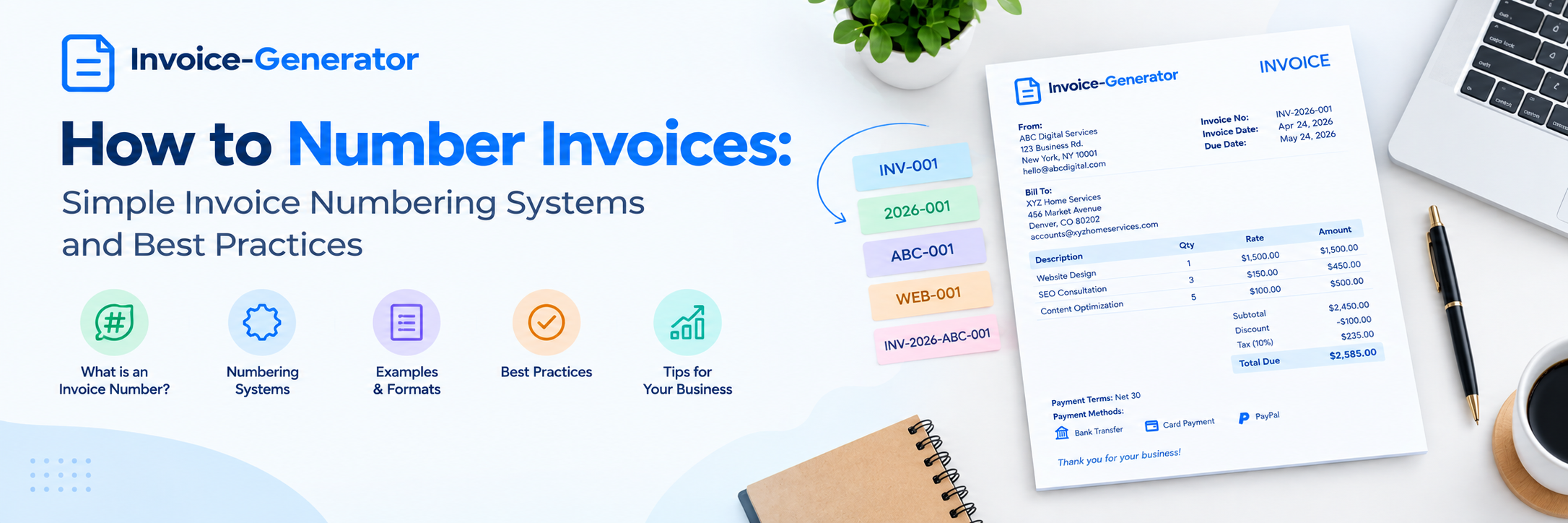
A small business can start with a simple sequence such as INV-001, INV-002, and INV-003. Other businesses may use a year, customer code, project number, or another consistent format.
In this guide, we'll explain how invoice numbers work, different numbering systems you can use, examples of invoice numbers, common mistakes, and how to choose a system that works for your business.
What Is an Invoice Number?
An invoice number is a unique identifier assigned to a specific invoice.
For example:
Invoice Number: INV-001
The next invoice might be:
Invoice Number: INV-002
The number gives the invoice its own reference. When a customer asks about an invoice, you can use that number to locate the correct document.
For example, instead of saying:
"I'm asking about the invoice I sent you last month."
You can say:
"I'm following up on invoice INV-026."
That small difference can make invoice management much easier.
Why Do Invoices Need Numbers?
Invoice numbers help businesses keep their billing records organized.
A numbering system can help you:
-
Identify individual invoices
-
Track outstanding payments
-
Match payments with invoices
-
Find older invoices
-
Avoid duplicate records
-
Communicate with customers more clearly
-
Keep financial records organized
Imagine that you have sent 300 invoices during the year.
Without a reference number, finding one particular invoice can take time.
With a unique number such as INV-2026-247, you can identify the invoice immediately.
How Do You Number Invoices?
There is no single numbering format that every business must use.
The important principles are simple:
-
Give each invoice a unique number.
-
Use a consistent format.
-
Avoid duplicate numbers.
-
Keep your numbering system easy to understand.
-
Make sure the system works as your business grows.
For a small business, the easiest starting point is sequential numbering.
Example
-
INV-001
-
INV-002
-
INV-003
-
INV-004
-
INV-005
You don't need to create a complicated numbering structure if your business does not need one.
5 Simple Invoice Numbering Systems
Different businesses have different needs. Here are five practical approaches.
1. Sequential Invoice Numbering
This is the simplest system.
Each new invoice receives the next available number.
Example
-
INV-001
-
INV-002
-
INV-003
-
INV-004
-
INV-005
Who can use it?
Sequential numbering works well for:
-
Freelancers
-
Consultants
-
Small service businesses
-
Independent contractors
-
Small agencies
Advantages
It is:
-
Easy to understand
-
Easy to maintain
-
Easy to search
-
Suitable for businesses with straightforward billing
For many small businesses, this is all they need.
2. Year-Based Invoice Numbering
Some businesses include the year in the invoice number.
Example
-
INV-2026-001
-
INV-2026-002
-
INV-2026-003
-
INV-2026-004
When the new year begins, the sequence can start again:
-
INV-2027-001
-
INV-2027-002
-
INV-2027-003
Why use a year-based system?
It can make older invoices easier to identify.
If you see:
INV-2025-184
you immediately know which year the invoice belongs to.
This approach can be useful for businesses that want their invoice references to reflect the billing year.
3. Customer-Based Invoice Numbering
A business can also include a customer code in its invoice number.
For example, if a customer is ABC Construction, you could assign the customer code ABC.
Invoices might then look like:
-
ABC-001
-
ABC-002
-
ABC-003
Another customer might have:
-
XYZ-001
-
XYZ-002
-
XYZ-003
When can this be useful?
Customer-based numbering can work for businesses with a smaller number of regular clients.
However, it can become harder to manage if you have hundreds or thousands of customers.
For that reason, it is usually better to keep the system simple unless you have a specific reason to organize invoices by customer.
4. Project-Based Invoice Numbering
Businesses that work on projects can include a project reference in the invoice number.
For example:
WEB-2026-001
could represent a website project.
Another project could use:
SEO-2026-001
This can be useful for:
-
Web development agencies
-
Construction companies
-
Design firms
-
Marketing agencies
-
Consultants
-
Contractors
A project-based system can make it easier to connect an invoice with a particular project.
5. Combination Invoice Numbering
A combination system uses more than one piece of information.
For example:
INV-2026-ABC-001
This could represent:
-
INV = invoice
-
2026 = year
-
ABC = customer
-
001 = invoice sequence
Another example:
INV-2026-WEB-015
could represent invoice number 15 for a website-related project in 2026.
Combination numbering can be useful for larger businesses, but it is not necessary for everyone.
If a simple system works, there is usually little reason to make it more complicated.
Invoice Number Examples
Here are some common invoice numbering formats:
| Numbering System | Example |
|---|---|
| Simple sequence | INV-001 |
| Number only | 1001 |
| Year + sequence | 2026-001 |
| Year + invoice | INV-2026-001 |
| Customer + sequence | ABC-001 |
| Project + sequence | WEB-001 |
| Year + customer + sequence | 2026-ABC-001 |
There is no universally correct format for every business.
Choose a format that you can maintain consistently.
Should Invoice Numbers Be Sequential?
Sequential numbering is one of the simplest ways to organize invoices, but businesses may use different systems depending on their needs and applicable requirements.
For example:
INV-001 → INV-002 → INV-003 → INV-004
makes it easy to see the general order in which invoices were created.
However, your invoice numbers do not necessarily need to follow this exact format if another consistent system better suits your business.
The key is to avoid duplicate numbers and maintain reliable records.
If your accounting or tax system has specific invoice-numbering requirements, follow those requirements.
Can Invoice Numbers Include Letters?
Yes, businesses can use letters in invoice numbers when their chosen system allows it.
For example:
-
INV-001
-
PROJ-001
-
WEB-2026-014
-
ABC-2026-008
Using letters can help explain what a number represents.
For example:
WEB-2026-014
could indicate a website-related invoice from 2026.
However, keep the format easy to read. There is usually no benefit in creating an invoice number that is so complicated that nobody can understand it.
Can Invoice Numbers Start at 001?
Yes, a business can choose to start its invoice numbering system at 001, provided that this fits its record-keeping requirements.
For example:
-
INV-001
-
INV-002
-
INV-003
Starting at 001 is common because it makes the sequence easy to understand.
If your business already has invoices, you do not necessarily need to restart your numbering system just because you are changing your invoice design or software.
Keep your existing records organized and choose the next appropriate unique number.
What Happens If You Use the Same Invoice Number Twice?
Using the same invoice number for two invoices can create confusion.
For example:
INV-025 — Customer A — $500
and
INV-025 — Customer B — $750
Now there are two different transactions with the same reference.
This can make it harder to:
-
Match payments
-
Find invoices
-
Reconcile records
-
Communicate with customers
-
Identify outstanding balances
If you discover a duplicate invoice number, do not simply ignore it.
Review your records and correct the numbering according to your accounting and record-keeping process. If the invoice has already been issued or recorded, keep a clear audit trail rather than silently changing historical records.
Can You Change an Invoice Number After Sending an Invoice?
It depends on the situation and how the invoice has been recorded.
If an invoice has already been sent to a customer, changing its number without documenting the change can create confusion.
For example:
Original: INV-025
Later changing it to:
INV-026
could cause problems if the customer has already recorded INV-025 in their accounting system.
If an invoice needs to be corrected, follow your normal accounting process and any applicable local requirements. In some situations, the appropriate approach may involve cancelling or correcting the original document and issuing a new one.
Keep a record of what happened.
What Is the Best Invoice Numbering System for a Small Business?
For many small businesses, a simple sequential system is enough.
For example:
INV-001
INV-002
INV-003
If you want to make the year visible, use:
INV-2026-001
INV-2026-002
INV-2026-003
The best system is not necessarily the most detailed one.
It is the system you can use consistently without creating extra administrative work.
Choose sequential numbering if:
You have a small number of invoices and simple billing.
Choose year-based numbering if:
You want to identify the invoice year quickly.
Choose project-based numbering if:
You manage multiple projects and want invoices connected to project references.
Choose a combination system if:
Your business has more complex billing and you genuinely benefit from additional identifiers.
How to Choose an Invoice Numbering System
Before choosing a format, ask yourself a few practical questions.
How many invoices do you send?
A freelancer sending 10 invoices a month may need a much simpler system than a company sending 10,000.
Do you work with recurring customers?
If you have a small group of regular customers, a customer reference may be useful.
Do you manage projects?
If your business works on large projects, a project reference can make invoice tracking easier.
Do you need to identify the year?
If you maintain large numbers of historical invoices, adding the year may help.
Will the system still work in five years?
Think beyond your current invoice count.
A numbering system that works for 20 invoices should not become impossible to manage when you have 2,000.
Invoice Numbering for Freelancers
Freelancers usually do not need a complicated numbering system.
A simple sequence can work well:
-
INV-001
-
INV-002
-
INV-003
Or:
-
INV-2026-001
-
INV-2026-002
-
INV-2026-003
If you work on several long-term projects, you can include a project reference.
For example:
BRAND-2026-004
The most important thing is consistency.
If you are new to invoicing and want to understand the complete process, see our guide on how to create an invoice.
Invoice Numbering for Small Businesses
A small business may have multiple customers, services, and billing schedules.
Even then, the invoice numbering system can remain simple.
For example:
INV-2026-101
This tells you that the invoice belongs to your 2026 sequence.
You can maintain the numbering in your invoicing software, spreadsheet, or invoice records.
If your business has multiple departments or locations, a more detailed system may be useful.
However, avoid adding identifiers that do not serve a real purpose.
Invoice Numbering for Contractors and Project Businesses
Contractors and project-based businesses may handle multiple jobs at the same time.
A project-based reference can help connect an invoice to the right job.
For example:
KITCHEN-2026-003
or:
JOB-4587-INV-02
The invoice number can work alongside a separate project or job number.
This distinction is useful because the invoice number identifies the billing document, while a project or job number identifies the work itself.
Invoice Number vs. Customer Number
These two numbers serve different purposes.
Invoice number
Identifies a specific invoice.
Example:
INV-2026-025
Customer number
Identifies the customer.
Example:
CUS-1048
A customer can have many invoices.
For example:
CUS-1048
might have:
-
INV-2026-021
-
INV-2026-025
-
INV-2026-031
Keeping these identifiers separate can make your records easier to manage.
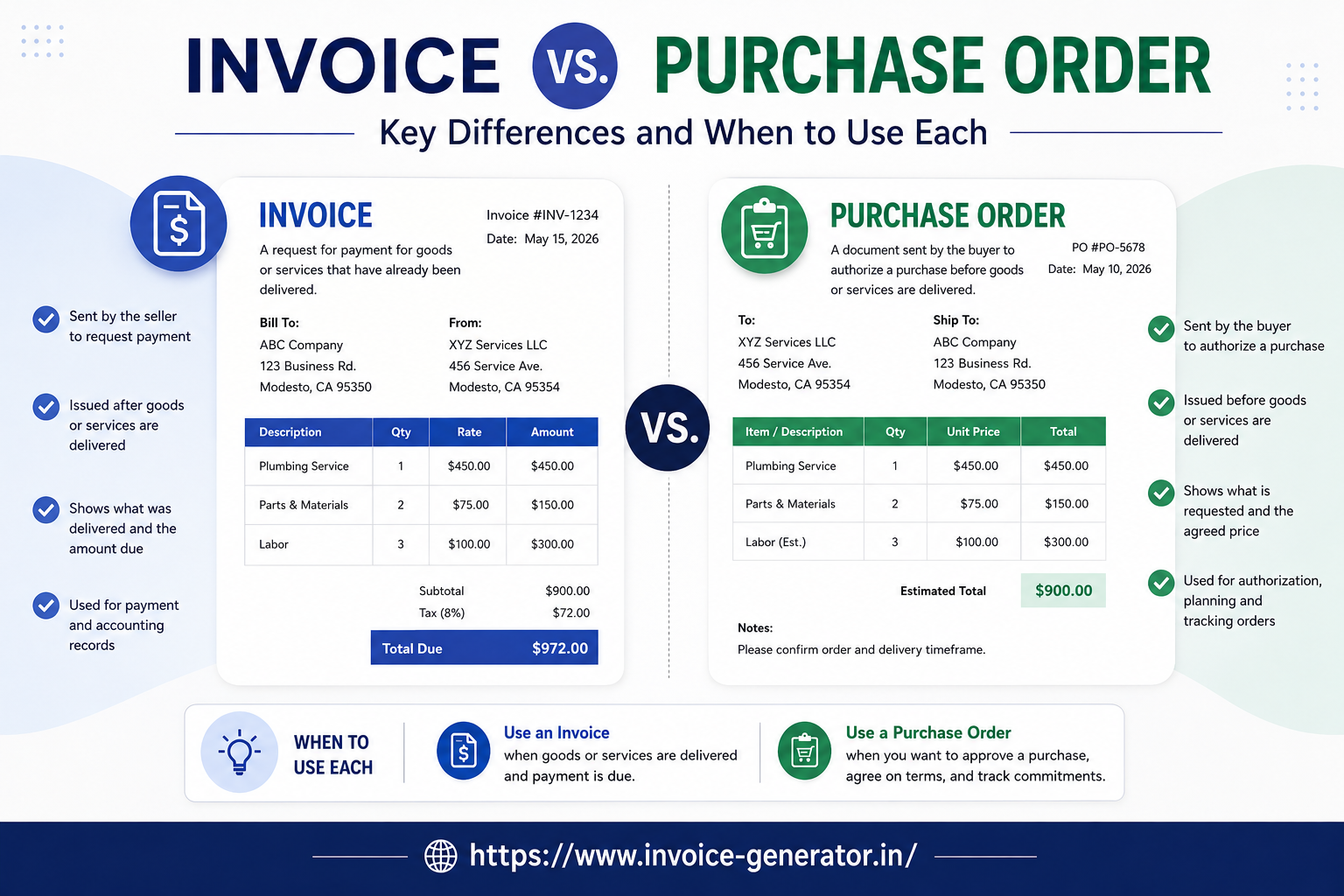
Invoice Number vs. Purchase Order Number
An invoice number and purchase order number are also different.
Invoice number
Created by the seller to identify the invoice.
Purchase order number
Usually created by the buyer to identify an approved purchase or order.
A customer may ask you to include their purchase order number on your invoice.
For example:
Invoice Number: INV-2026-025
Purchase Order: PO-7845
Including both references can help the customer's accounts payable team match the invoice with the original order.
Should Every Invoice Have a Unique Number?
A unique invoice number is an important part of organized invoicing.
Each invoice should have a reference that allows you to distinguish it from other invoices.
This is especially important when you have:
-
Multiple customers
-
Recurring invoices
-
Large numbers of transactions
-
Multiple projects
-
Accounting software
-
Manual financial records
If your local tax or accounting rules specify particular invoice-number requirements, those rules should take priority.
Common Invoice Numbering Mistakes
Starting a New Sequence Every Month Without a Reason
For example:
-
January: INV-001
-
February: INV-001
-
March: INV-001
This can create duplicate invoice numbers.
If you want to include the month, use a structure that keeps the complete number unique.
For example:
INV-2026-01-001
and:
INV-2026-02-001
Using Random Numbers
Numbers such as:
-
58392
-
10473
-
92715
may technically identify invoices, but they provide little structure.
A consistent system is easier to maintain.
Making Invoice Numbers Too Long
A number such as:
INV-2026-AUSTIN-WEB-DESIGN-CLIENT-ABC-00047
may contain useful information, but it is unnecessarily difficult to read.
Keep your numbering system practical.
Reusing Old Invoice Numbers
Once an invoice number has been assigned, avoid reusing it for another invoice.
Historical references should remain clear.
Changing the System Too Often
Changing from:
INV-001
to:
2026-ABC-001
and then to:
BILL-0001
can make your records harder to understand.
Choose a system and stick with it unless there is a genuine reason to change.
Invoice Numbering Best Practices
1. Keep Every Invoice Number Unique
Do not assign the same number to two different invoices.
2. Use a Consistent Format
Decide how your numbers will look and use the same structure.
3. Keep It Simple
Do not add information that you will not actually use.
4. Plan for Growth
Choose a system that can handle more customers and invoices later.
5. Keep Good Records
Your invoice numbering system works best when supported by organized records.
6. Avoid Unnecessary Changes
Changing the format frequently can create confusion.
7. Check Applicable Requirements
Some jurisdictions, industries, or accounting systems may have specific invoicing rules.
8. Make the Number Easy to Read
Avoid unnecessary characters or complicated codes.
9. Keep Customer and Invoice References Separate
A customer number identifies the customer. An invoice number identifies the invoice.
10. Review Your System Regularly
As your business grows, check whether your numbering system is still practical.
A Simple Invoice Numbering Example
Imagine that Sarah runs a freelance web design business.
She decides to use a year-based sequential system.
Her first three invoices in 2026 are:
INV-2026-001
INV-2026-002
INV-2026-003
She sends another invoice to an existing customer.
That invoice becomes:
INV-2026-004
The following year, she starts a new year-based sequence:
INV-2027-001
The system is easy to understand and does not require a complicated database.
Invoice Numbering Checklist
Before you start using a numbering system, check:
-
Every invoice has a unique number
-
The numbering format is consistent
-
The format is easy to understand
-
You have a method for tracking used numbers
-
You are not reusing old invoice numbers
-
Your system can handle business growth
-
Customer and project references are separate where appropriate
-
Your system meets applicable requirements
Frequently Asked Questions About Invoice Numbers
What is an invoice number?
An invoice number is a unique reference assigned to an invoice. It helps businesses and customers identify, track, and discuss a specific invoice.
How should I number my invoices?
You can use a simple sequential system such as INV-001, INV-002, and INV-003. You can also include the year, customer, or project reference if it provides a useful organizational benefit.
Should invoice numbers be sequential?
Sequential numbering is a simple and practical option, but businesses can use different systems depending on their needs and applicable requirements.
Can an invoice number contain letters?
Yes. Formats such as INV-001, WEB-2026-005, or ABC-014 can be used when appropriate.
Can I start my invoice numbers at 001?
Yes, starting with INV-001 is a simple way to establish a numbering sequence.
Can two invoices have the same number?
Using the same invoice number for two different invoices can cause confusion and should generally be avoided.
What happens if I accidentally duplicate an invoice number?
Review your records and correct the issue using your normal accounting and record-keeping process. If the invoice has already been issued or recorded, keep a clear record of any correction.
Can I change an invoice number after sending it?
Changing an invoice number after it has been sent can create confusion. If a correction is necessary, follow your accounting process and applicable requirements and maintain a clear record of the change.
Do invoice numbers have to start at 001?
No. A business may use a different starting number or numbering structure depending on its circumstances and applicable requirements.
Is an invoice number the same as a purchase order number?
No. An invoice number identifies the seller's invoice, while a purchase order number generally identifies the buyer's purchase order.
Should invoice numbers reset every year?
They can, particularly when using a year-based system. For example, a business may use INV-2026-001 and then begin with INV-2027-001 the following year. The important point is to maintain clear and unique records.
Do invoices need a unique number?
A unique invoice reference is an important part of organized invoicing and may also be subject to specific requirements depending on the jurisdiction and transaction.
How Invoice Numbers Fit Into the Rest of Your Invoice
An invoice number is only one part of a complete invoice.
Your invoice also needs relevant information about the seller, customer, products or services, prices, taxes, payment terms, and amount due.
If you want to understand what an invoice include in more detail, our complete guide explains the essential elements and provides examples.
Once you understand the required information, creating the document itself becomes much easier.
Create an Invoice With a Consistent Numbering System
A good invoice numbering system does not need to be complicated.
For many freelancers and small businesses, a simple sequence such as INV-001, INV-002, and INV-003 is enough. Businesses with more complex operations may benefit from adding the year, customer reference, or project number.
The important thing is to choose a system that is unique, consistent, easy to understand, and practical to maintain.
If you want to [make an invoice online for free], an online invoice generator can help you create invoices while keeping your invoice information organized.
With a consistent numbering system in place, every invoice has a clear identity, making it easier to track billing, follow up on payments, and maintain business records.
Ready to send your next invoice?
Free, no sign-up, print-ready PDF in under a minute.