Invoice
What Is a Pro Forma Invoice? Meaning, Example, and When to Use One.
A customer asks for an invoice before confirming an order or making a payment. You know the price, but the sale has not been finalized yet. What should you send?
In many situations, a pro forma invoice is the right document.
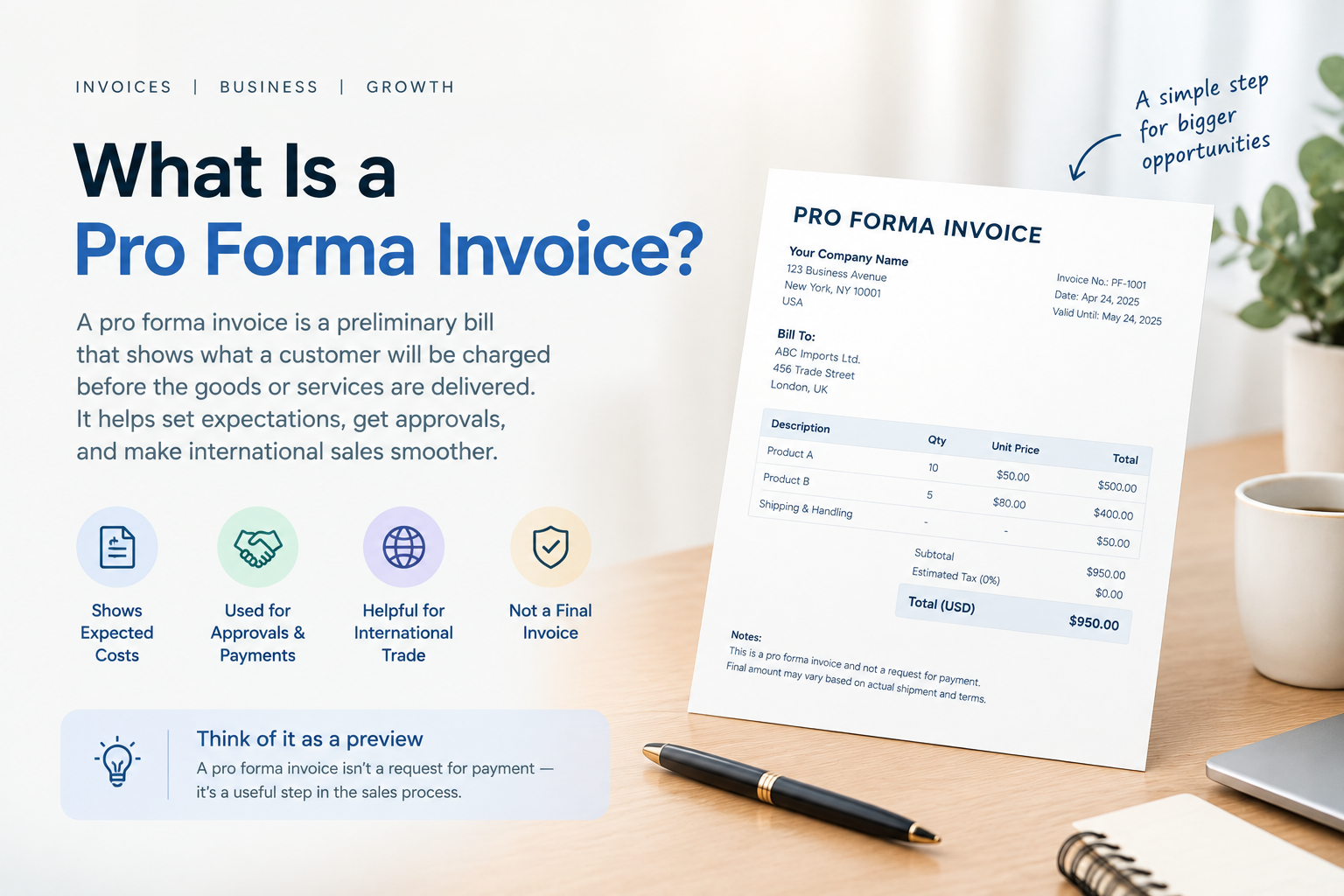
A pro forma invoice provides an estimated or proposed breakdown of the goods or services, prices, and expected charges before a transaction is finalized. It helps the buyer review the costs and understand the proposed terms.
In this guide, you'll learn what a pro forma invoice means, when to use one, what it should include, and how it differs from a regular invoice.
What Is a Pro Forma Invoice?
A pro forma invoice is a preliminary commercial document that outlines the expected details of a proposed sale. It typically includes product or service descriptions, quantities, prices, applicable estimated taxes or charges, and the expected total.
Businesses commonly use pro forma invoices when a customer needs to review costs before confirming an order, arranging payment, or completing an international transaction.
Unlike a final invoice, a pro forma invoice generally requests no payment as a final bill and does not, by itself, establish that a sale has been completed. Its legal and tax treatment can vary by jurisdiction and transaction.
For a broader introduction to invoicing, see our guide on what an invoice is, its types, and how invoicing works.
What Is a Pro Forma Invoice Used For?
A pro forma invoice can be useful in several situations.
1. Providing a price breakdown before an order
A buyer may want to see the expected total before approving a purchase. A pro forma invoice lays out the proposed items, quantities, prices, and charges.
2. Requesting an advance payment
A business may issue a pro forma invoice to communicate the amount expected before work begins or goods are supplied. The actual advance-payment arrangement should be agreed with the customer and documented appropriately.
3. Supporting international trade
Importers and exporters may use pro forma invoices to communicate proposed shipment details and estimated values. Customs authorities may require specific documents and information, so a pro forma invoice should not be assumed to replace a commercial invoice or other required paperwork.
4. Confirming the expected cost of a service
Consultants, freelancers, agencies, and contractors may provide a pro forma invoice to show the proposed cost of a project before the customer commits.
5. Helping buyers plan their budgets
A preliminary breakdown gives the buyer a clearer view of the expected financial commitment before proceeding.
Pro Forma Invoice Example
Imagine a business selling office furniture to a customer. The customer wants to review the cost before confirming the order.
Here is a simplified example of the proposed charges.
PRO FORMA INVOICE
Seller: ABC Office Supplies
Buyer: Greenfield Consulting
Pro forma number: PF-2026-014
Issue date: October 12, 2026
Valid until: October 26, 2026
| Description | Quantity | Unit price | Amount |
|---|---|---|---|
| Office desks | 5 | $200.00 | $1,000.00 |
| Office chairs | 5 | $100.00 | $500.00 |
| Subtotal | $1,500.00 | ||
| Estimated delivery | $75.00 | ||
| Estimated tax | As applicable | ||
| Estimated total before applicable tax | $1,575.00 |
Payment terms: As agreed before order confirmation.
This is an illustrative example. Actual tax, customs, and invoicing requirements depend on the transaction and jurisdiction.
The buyer can review the proposed costs and decide whether to proceed. If the order is confirmed and a final invoice becomes appropriate, the seller should issue the correct document under the agreed terms and applicable rules.
What Should a Pro Forma Invoice Include?
The exact requirements depend on the purpose of the document and the applicable rules, but a useful pro forma invoice generally includes:
-
Document title: Clearly label it “Pro Forma Invoice.”
-
Seller details: Business name, address, and contact information.
-
Buyer details: Customer or business name and relevant contact information.
-
Document number: A unique reference number for identification.
-
Issue date: The date the document was prepared.
-
Validity date: If the quoted prices or terms expire.
-
Product or service descriptions: Explain what is being offered.
-
Quantities and unit prices: Show how the proposed charges are calculated.
-
Subtotal and discounts: Where relevant.
-
Estimated taxes and additional charges: Identify these clearly and avoid presenting estimates as confirmed amounts.
-
Total estimated amount: Show the expected cost.
-
Proposed payment terms: Explain any advance payment or payment arrangements.
-
Delivery or service details: Include expected timing or shipping information when relevant.
If you're preparing your first invoice document, our guide on what an invoice should include provides a useful checklist.
Pro Forma Invoice vs. Regular Invoice
Although these documents may contain similar information, they serve different purposes.
| Feature | Pro forma invoice | Regular or final invoice |
|---|---|---|
| Main purpose | Communicates proposed transaction details | Requests payment for a transaction or completed billing event |
| Timing | Usually issued before the sale or final billing | Issued when billing is appropriate under the agreement and applicable rules |
| Amount | May be estimated or subject to confirmation | States the amount being billed |
| Payment request | Usually preliminary, not a final demand for payment | Commonly includes a payment due date and instructions |
| Accounting treatment | Generally not treated as a final sales invoice by itself | May be recorded as a receivable or sales document according to accounting rules |
| Tax treatment | Depends on local rules and the transaction | Depends on applicable invoicing and tax requirements |
The key difference: A pro forma invoice outlines a proposed transaction. A regular invoice is used to bill the customer under the agreed terms.
Do not assume that simply labelling a document “pro forma” determines its legal or tax treatment. The substance of the transaction and local requirements matter.
Pro Forma Invoice vs. Quote or Estimate
A quote, estimate, and pro forma invoice can all communicate expected costs, but they are not always interchangeable.
-
Quote: Typically states the price and terms offered to a potential customer.
-
Estimate: Provides an approximate expected cost that may change as more information becomes available.
-
Pro forma invoice: Presents proposed transaction details in an invoice-style format, often for buyer review, advance-payment arrangements, or trade documentation.
Businesses may use these documents differently depending on their industry and local practices. Make the purpose of each document clear to avoid confusion about whether an order has been accepted or payment is due.
How to Create a Pro Forma Invoice
Follow these steps to prepare a clear preliminary invoice.
Step 1: Enter the seller and buyer details
Add the correct business and customer information so both parties can identify the proposed transaction.
Step 2: Describe the products or services
List each item or service separately. Include quantities, unit prices, and relevant specifications where needed.
Step 3: Calculate the proposed charges
Add the line amounts, subtract applicable discounts, and identify estimated delivery fees or other charges.
Step 4: Review the tax treatment
Determine whether taxes should be shown and how they should be calculated for the transaction. If the tax position is uncertain, clearly distinguish estimates from confirmed amounts and obtain appropriate advice.
Step 5: State the payment and validity terms
Explain whether an advance payment is proposed, when the quotation expires, and what conditions apply before the transaction proceeds.
Step 6: Label the document clearly
Use the heading “Pro Forma Invoice” so the buyer can distinguish it from a final invoice.
Step 7: Review before sending
Check the prices, quantities, customer details, dates, and proposed terms. Keep a copy for your records.
Once the transaction proceeds, prepare the appropriate final invoice when required. Our guide on how to create an invoice explains the standard invoice preparation process.
Common Pro Forma Invoice Mistakes to Avoid
Using the wrong document title. Clearly identify the document as a pro forma invoice to avoid confusing it with a final bill.
Treating estimated amounts as final. If prices, taxes, or shipping costs may change, explain that clearly.
Leaving out important terms. Include relevant payment, validity, delivery, or service conditions.
Assuming it replaces a commercial invoice. International shipments may require separate commercial invoices and other documents.
Using unclear payment instructions. If an advance payment is proposed, specify the amount and conditions agreed with the buyer.
Failing to prepare the final invoice. A pro forma invoice does not automatically replace the final billing document when one is required.
Can You Create a Pro Forma Invoice With a Free Invoice Generator?
You can use the free online invoice generator to prepare a professional invoice-style document without signing up.
Before using any invoice generator for a pro forma invoice, confirm that it lets you label the document correctly and include the details your transaction requires. If the tool does not support a pro forma title or the necessary fields, use a suitable template instead.
The important thing is to make the document's purpose clear, check every amount, and avoid treating a preliminary document as a final invoice when the transaction requires a separate billing document.
Frequently Asked Questions
Is a pro forma invoice a real invoice?
It is a preliminary commercial document, but it generally does not function as the final payment invoice by itself. Its legal effect depends on the transaction and applicable rules.
Does a pro forma invoice mean payment is due?
Not necessarily. It usually communicates proposed charges before the transaction is finalized. Any advance-payment requirement should be stated clearly and agreed upon by the parties.
Can a pro forma invoice be used for customs?
It may be used to communicate proposed transaction details during import or export planning. However, customs authorities may require a commercial invoice or other documents depending on the shipment and applicable rules.
Should a pro forma invoice have an invoice number?
It should have a unique reference number for identification and recordkeeping. Businesses may use a separate numbering series for pro forma documents to distinguish them from final invoices.
Can I convert a pro forma invoice into a final invoice?
You can use the preliminary document as a reference when preparing the final invoice. Review the actual quantities, prices, taxes, and transaction details, and issue the appropriate final document rather than assuming the preliminary document is sufficient.
What is the difference between a pro forma invoice and a receipt?
A pro forma invoice outlines a proposed transaction. A receipt generally acknowledges that payment has been received. Read our guide on invoice vs. receipt for more details.
Final Thoughts
A pro forma invoice helps buyers understand the expected cost of a proposed transaction before it is finalized. It is especially useful for preliminary price breakdowns, advance-payment discussions, and certain international trade processes.
Keep the document clearly labelled, show the proposed charges, and state the relevant terms. When the transaction proceeds, issue the appropriate final invoice and follow the tax and documentation rules that apply.
For more practical invoicing guidance, explore the Invoice-Generator.in Blog.
Ready to send your next invoice?
Free, no sign-up, print-ready PDF in under a minute.